

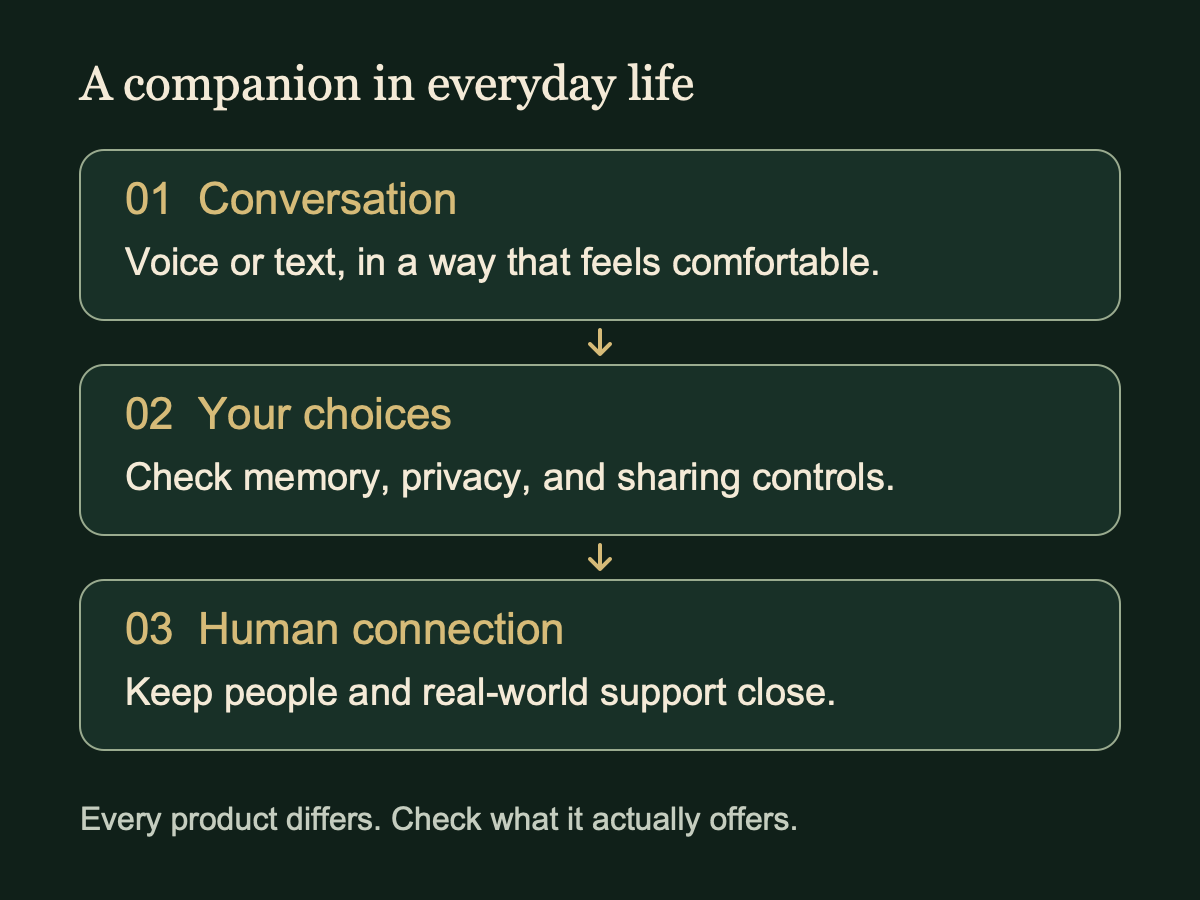
Companions vary. Some use a dedicated device, while others work on a phone, tablet, or computer. Before choosing one, check how it handles conversations, what it remembers, and who can see that information.
What can an AI companion do?
Every AI companion is different, but many are designed to help with everyday life rather than perform a single task. Some focus mostly on companionship. Others combine conversation with organization, memory preservation, or private family communication.
- Hold natural conversations using voice or text
- Remember selected details over time
- Help organize appointments and reminders
- Encourage daily routines and healthy habits
- Answer general questions
- Help preserve family stories and memories
- Make it easier to stay connected with loved ones
How is an AI companion different from Alexa or Siri?
Traditional voice assistants are excellent at completing quick tasks. You might ask for the weather, set a timer, or turn off a light.
An AI companion centers ongoing conversation and everyday support. General-purpose assistants increasingly overlap with that role: Amazon describes Alexa+ as conversational and able to remember information. Compare how each product handles memory, consent, and the kind of conversation you want.
It is less like using a remote control and more like talking with something that gets to know you.
Can an AI companion replace family or friends?
No. A responsible AI companion should never try to replace the people who matter most. Family, friends, neighbors, caregivers, and healthcare professionals all provide relationships and care that technology cannot reproduce.
An AI companion can provide support between those moments. It might help someone remember an appointment before a loved one calls, invite a favorite memory during a quiet afternoon, or simply offer conversation when no one else is nearby.
The goal is not replacing human relationships. It is helping people stay connected, engaged, and independent.
Are AI companions safe?
Like any technology, an AI companion should be considered with both its benefits and limitations in mind. A trustworthy product should clearly explain what it remembers, how information is protected, who can access conversations, and what the companion can and cannot do.
AI can make mistakes. It should never be considered emergency assistance, medical care, or a replacement for professional advice. Understanding those boundaries helps people make an informed decision about whether a companion is right for them.
How Kulohi approaches AI companionship
Kulohi was built around a simple idea: technology should support independence, not take it away.
Robin, Kulohi’s voice-first AI companion, is designed to help older adults stay organized, preserve chosen memories, and enjoy natural conversation while respecting privacy and personal choice.
Kulohi does not focus on monitoring or constant oversight. It emphasizes dignity, familiar conversation, and giving members control over what they choose to remember or share.
Our goal is not to replace relationships. It is to help strengthen them.
Sources and further reading
- Amazon: Introducing Alexa+: Amazon describes Alexa+ as conversational and personalized, with memory. Compare current products rather than assuming every general-purpose assistant only follows short commands.
- NIST: AI Risk Management Framework: A framework for understanding AI risks and the qualities of trustworthy systems; useful context for questions about reliability and transparency.
- FTC: Secure your voice assistant and protect your privacy: Practical guidance on microphone settings, recordings, account security, and permissions for devices that respond to voice.
Frequently asked questions
Questions people often ask.
Is an AI companion difficult to use?
Not necessarily. Many AI companions work through natural conversation, which can be easier than navigating complicated menus or learning unfamiliar controls.
Do I have to type?
Many AI companions, including Kulohi, support voice and text so people can use whichever feels most comfortable.
Does an AI companion remember previous conversations?
Some do. Memory varies by platform. A responsible product should explain what can be remembered and give the person meaningful control over it.
Is an AI companion always listening?
Most companions only process a conversation while they are actively being used. Practices differ, so reviewing each company’s privacy information is important.
Is Kulohi available now?
Kulohi is welcoming members through a phased beta program. You can request access and learn more about Robin on this website.
Final thoughts
What matters most.
Artificial intelligence cannot replace the warmth of family, the comfort of old friends, or the care of dedicated professionals. What it can do is make everyday life a little easier.
The best AI companions are not designed to take over. They are designed to support, encourage, and help people remain connected to the lives they already love.
The most important measure is how thoughtfully the technology fits into everyday life.